
Ai Content Generator
Ai Picture
Tell Your Story

 DTF Manchester
Rolling Gang Sheet Builder for Custom DTF Layouts
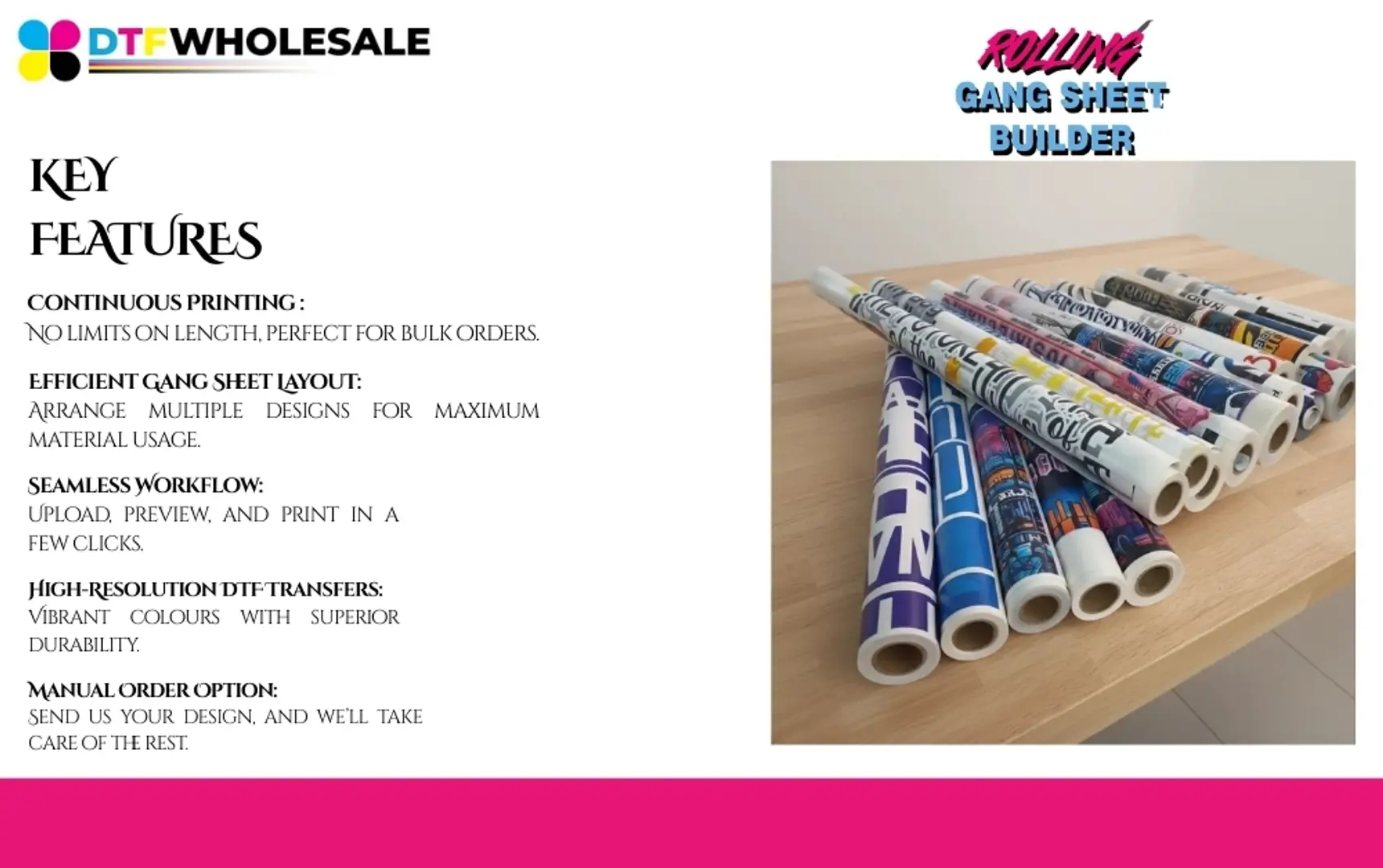
A Rolling Gang Sheet Builder is an advanced layout solution designed to simplify and optimize the creation of custom DTF layouts on continuous film rolls. As Direct to Film printing continues to evolve, printers are moving away from rigid, fixed-size sheets and adopting rolling layouts that offer greater flexibility, efficiency, and control. This shift has made rolling gang sheet builders an essential tool for modern DTF printing workflows.
Unlike traditional gang sheets that restrict designs to a single page size, rolling gang sheets allow designs to flow continuously along the length of the film. This approach reduces wasted space, improves cutting accuracy, and supports high-volume production without compromising layout precision. Whether you operate a small print shop or manage large custom orders, a rolling gang sheet builder helps ensure clean, consistent, and press-ready results.
What Is a Rolling Gang Sheet Builder
A rolling gang sheet builder is a digital layout tool created specifically for DTF printers that use roll-fed film. Instead of defining a fixed height, the tool allows users to build layouts that extend vertically as long as needed while maintaining a constant film width.
Users can upload multiple designs, control their size, spacing, and order, and arrange them in a continuous sequence. Once finalized, the builder exports a single print-ready file that runs smoothly through the DTF printer. This makes the tool ideal for producing custom DTF layouts that adapt to varying quantities and design sizes.
The main purpose of a rolling gang sheet builder is to give printers flexibility without sacrificing accuracy.
How Rolling Gang Sheets Differ From Standard Gang Sheets
Standard gang sheets operate within predefined dimensions such as 560mm x 1000mm. While effective for certain jobs, they can be limiting when handling mixed designs or fluctuating order quantities. Any unused space within a fixed sheet often goes to waste.
A rolling gang sheet removes these limitations by allowing designs to be placed continuously down the roll. This means layouts can expand or contract based on actual needs rather than forced boundaries. The result is better material usage and smoother production planning.
This difference is especially noticeable in bulk printing environments, where rolling layouts allow uninterrupted printing and cutting.
Why Rolling Gang Sheet Builders Matter in DTF Printing
DTF printing relies on precision at every stage. Layout errors lead to wasted film, poor cutting alignment, and slower heat press application. A rolling gang sheet builder reduces these risks by standardizing how designs are placed and spaced.
By using a builder tool, printers gain better control over layout flow, ensuring designs are neither overcrowded nor inconsistently spaced. This level of control improves cutting accuracy and reduces handling time during heat pressing.
In short, rolling gang sheet builders help transform complex design batches into organized, manageable print files.
Core Features of a Rolling Gang Sheet Builder
A well-designed rolling gang sheet builder includes several essential features that support accurate and efficient layout creation.
One of the most important features is a continuous layout canvas that mirrors the width of the DTF film roll. This allows users to visualize exactly how designs will print.
Precise size controls ensure each design prints at the correct dimensions. Spacing and alignment tools help maintain clean separation between designs, improving cutting accuracy.
Duplicate and repeat options are useful for bulk orders, while export-ready files ensure compatibility with DTF printers. Together, these features support Rolling Gang Sheet Layouts that are consistent and production-ready.
Benefits of Using a Rolling Gang Sheet Builder
One of the most noticeable benefits is improved film efficiency. By eliminating fixed sheet constraints, rolling layouts make better use of available film space, reducing waste.
Another key advantage is faster workflow. Printers can prepare one continuous file instead of managing multiple sheets, saving time during setup and production.
Rolling layouts also simplify cutting. Designs appear in a logical sequence, making trimming easier and reducing errors. This improves overall workflow efficiency and consistency.
For businesses handling multiple custom orders, these benefits quickly translate into smoother daily operations.
Ideal Use Cases for Rolling Gang Sheet Builders
Rolling gang sheet builders are especially useful for custom apparel businesses, online DTF transfer sellers, and print shops handling mixed or high-volume orders.
They are ideal for scenarios involving multiple logo sizes, varied artwork shapes, or different garment placements such as chest prints, sleeve graphics, and back designs.
Because the layout adapts dynamically, rolling builders are well-suited for both small runs and large production batches.
Design Accuracy and Print Consistency
Accuracy is critical in DTF printing. Even small layout mistakes can affect the final application. A rolling gang sheet builder helps maintain consistent margins, spacing, and alignment across long print runs.
This consistency ensures designs apply cleanly during heat pressing and maintain durability after washing. When layouts are predictable and precise, print quality improves across every garment.
Reliable design accuracy reduces reprints and enhances overall production confidence.
Best Practices for Building Rolling Gang Sheets
To get the best results, always start with high-resolution artwork. Poor-quality files lead to disappointing prints, regardless of layout quality.
Maintain consistent spacing between designs to simplify cutting. Group similar sizes together where possible, and always review measurements before exporting the final file.
A full visual review of the entire roll layout helps catch errors early and prevents costly mistakes during printing.
Common Mistakes to Avoid
One common mistake is overcrowding designs to save space. While efficiency is important, insufficient spacing can cause cutting issues.
Another issue is relying entirely on automatic placement without reviewing the layout. Even the best tools require human oversight.
Pros and Cons of a Rolling Gang Sheet Builder
Pros
Efficient use of continuous DTF film
Flexible layout creation for mixed designs
Faster preparation for bulk orders
Improved cutting and pressing workflow
Consistent layout accuracy
Cons
Limited artwork editing capabilities
Requires careful review for long layouts
Learning curve for first-time users
Internet dependency for online tools
Understanding both advantages and limitations helps users apply the tool effectively.
How Rolling Gang Sheets Improve Production Flow
DTF Gang Sheet Builder reduces file clutter by consolidating designs into one continuous layout. This simplifies coordination between printing, cutting, and pressing stages.
With fewer interruptions and clearer sequencing, production becomes more predictable and organized. Over time, this leads to fewer errors and better output consistency.
A structured workflow improves efficiency without increasing complexity.
Future of Rolling Gang Sheet Layouts
As DTF printing technology advances, rolling gang sheet builders are becoming smarter and more intuitive. Improved automation and preview systems are making layout creation faster and more accurate.
These tools are evolving to support high-demand environments where speed and precision are equally important. Adopting rolling layouts now helps printers stay aligned with modern production standards.
FAQs – Rolling Gang Sheet Builder
What is a rolling gang sheet builder?
It is a tool used to create continuous DTF layouts on film rolls.
Who should use rolling gang sheets?
Print shops, apparel brands, and high-volume DTF printers.
Can multiple design sizes be used together?
Yes, different sizes and designs can be placed on one rolling layout.
Does it reduce film waste?
Yes, it improves space usage compared to fixed-size sheets.
Is manual review still required?
Yes, reviewing the final layout helps prevent errors.
Related Posts
© 2026 Invastor. All Rights Reserved
User Comments